
Norway's Pet Travel Rules 2026: EU Legislation and Unclear National Requirements
Norway's adoption of new EU pet travel legislation has raised questions about national requirements, implementation dates and legal clarity. What rules must pet owners follow when travelling with dogs and cats to Norway in 2026?

Switzerland's Pet Travel Rules 2026: When Animal Protection Becomes Bureaucracy
Switzerland is introducing revised pet travel regulations from 15 November 2026, but questions remain about permit requirements, overlapping implementation dates and the burden placed on pet owners. We examine the legislation and ask whether the syst
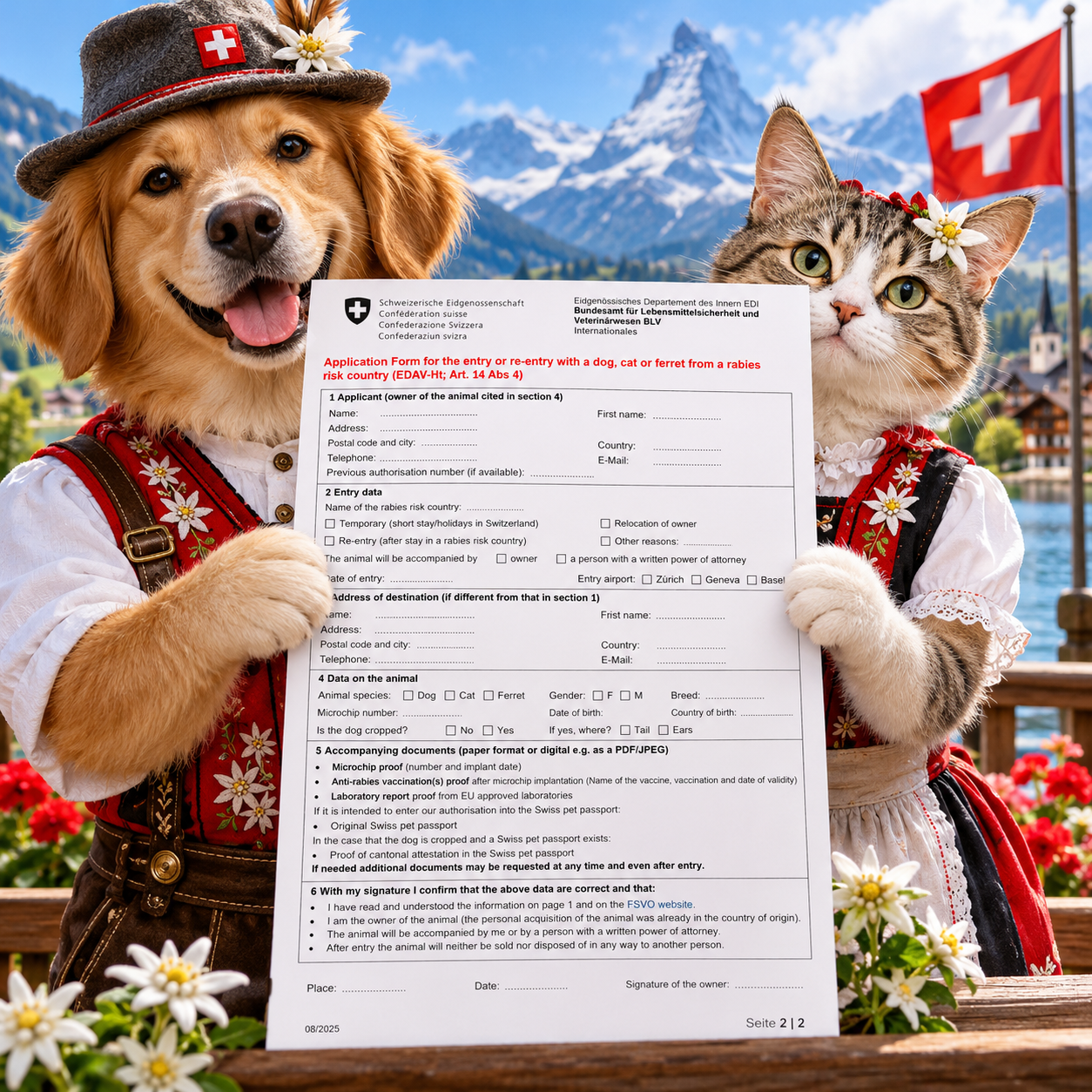
Switzerland Pet Travel Rules 2026: FSVO Import Authorisation and Rabies Changes
Switzerland is updating its pet travel rules from 15 November 2026. Find out when an FSVO import authorisation is required, how to apply, the rabies titre test requirements, and what changes for dogs and cats travelling from Serbia and Montenegro.

From St Petersburg to Dubai with K9 JETS: A Bernese Mountain Dog's Extraordinary Journey
The extraordinary journey of Rudiger, a Bernese Mountain Dog travelling from St Petersburg to Dubai via Europe and London. Discover the challenges of veterinary paperwork, the urgent UK export health certificate, an unforgettable K9 JETS private flig

Из Санкт-Петербурга в Дубай с K9 JETS: путешествие Рюдигера
История путешествия бернского зенненхунда Рюдигера из Санкт-Петербурга в Дубай через Европу и Лондон. Ветеринарные документы, срочное оформление британского сертификата 3926EHC, перелёт с K9 JETS и удивительное гостеприимство Jetex Dubai.
 Loading More Items

Norway's Pet Travel Rules 2026: EU Legislation and Unclear National Requirements
Information checked and updated: 5 November 2026
Norway's Pet Travel Rules: EU Legislation, National Exceptions and Unanswered Questions
European regulations have been incorporated into the EEA Agreement. Norway is still working through its national rules. Where does that leave pet owners?
Travelling internationally with a pet is complicated enough without having to work out which version of the law a country is applying.
Yet that is precisely the question now facing people planning journeys with dogs, cats and other pets to Norway.
On 22 April 2026, the European Union began applying its revised rules on the non-commercial movement of pet animals. Six months later, on 23 October, the EEA Joint Committee adopted Decision No 289/2026, incorporating the relevant European legislation into the EEA Agreement. The decision entered into force on 24 October 2026.
Norway's own Food Safety Authority, Mattilsynet, had meanwhile been advising travellers that the new EU rules did not, for the time being, change the requirements for bringing pets into Norway.
The difficulty is not simply that Norway follows European legislation. It is that the relationship between the European rules, their incorporation into the EEA Agreement and their application through Norwegian law is not immediately clear to the people expected to comply with them.
European rules, Norwegian implementation
Norway is not a member of the European Union, but it participates in the European Economic Area. Much of its animal health legislation is therefore based on European regulations incorporated into the EEA Agreement and implemented through Norwegian law.
Norway does have its own legal framework. The Norwegian Pet Regulations, known as the kjæledyrforskriften, are part of that framework.
The difficulty arises when European legislation changes and Norwegian authorities subsequently prepare domestic regulations to reflect those changes, potentially including additional national provisions.
On 2 October 2026, Mattilsynet published proposals for a new Norwegian regulation governing non-commercial pet movements, together with amendments to related animal health legislation. The consultation closed on 23 October.
The consultation expressly refers to implementing the revised EEA rules while introducing supplementary national provisions within the discretion available to Norway.
That leaves a straightforward question: which requirements have changed, which remain unchanged, and from exactly what date?
The dates that matter
Revised EU rules on non-commercial pet movements began to apply within the European Union.
23 April 2026
Mattilsynet reviewed its public guidance stating that the new EU rules did not yet change the requirements for bringing pets into Norway.
2 October 2026
Norway published proposals for revised national regulations, including supplementary national provisions.
23 October 2026
The Norwegian consultation closed. On the same date, EEA Joint Committee Decision No 289/2026 was adopted.
24 October 2026
The EEA Joint Committee decision entered into force.
These dates establish the legal developments, but they should not be confused with proof that every proposed Norwegian national provision has already entered into force.
Nor does incorporation into the EEA Agreement, by itself, establish the precise wording or commencement date of every domestic implementing measure.
The distinction matters. A legislative proposal, an adopted EEA decision and a national regulation currently in force are not interchangeable documents.
What exactly is a pet owner supposed to follow?
Consider somebody preparing to travel from the United Kingdom or another country outside the EU/EEA to Norway with a cat or dog.
The owner needs to know whether the required veterinary certificate is correct, whether the vaccination and identification records meet the applicable conditions, and whether the intended route creates any additional requirements.
These are not academic questions. A document prepared under the wrong rules may cause difficulties at check-in or border control.
The owner should not have to investigate the relationship between EU delegated regulations, EEA Joint Committee decisions, Norwegian implementing regulations and government guidance simply to establish which documents are required.
Mattilsynet's published guidance explains the position that applied when it was reviewed in April. However, the subsequent EEA decision of October makes it particularly important for the authorities to explain the current legal position and any transitional arrangements.
It is reasonable to expect that explanation to be clear, dated and accessible from the same official pages used by travellers.
National exceptions should not become a guessing game
Norway is entitled to make use of the national discretion provided for within the applicable legal framework. There is nothing inherently wrong with national provisions or with having a separate legislative procedure.
The criticism concerns transparency.
Where Norway adopts European legislation but retains additional national requirements or transitional arrangements, those differences need to be identified plainly. They should not be left for individual pet owners, veterinary practices or transport providers to reconstruct from several different legal documents.
It should be possible to find a single, authoritative explanation of the rules currently in force, the legal basis for each national exception and the date on which any change takes effect.
We have not established that Norway is operating undisclosed exceptions or that its published instructions are unlawful. What the official materials do demonstrate is a transition involving revised European legislation, an EEA incorporation decision and proposed Norwegian implementing measures.
That is quite enough complexity to justify demanding better public explanations.
The consequences are borne by animals and their owners
Legal uncertainty becomes a very practical problem at an airport, ferry terminal or border crossing.
If a traveller has misunderstood the applicable requirements, the consequences can include delayed journeys, refused transport, additional veterinary costs or problems obtaining permission for the animal to enter the country.
None of these outcomes is trivial when a living animal is involved.
A journey arranged around flights, veterinary appointments and time-sensitive certificates cannot always be rearranged without considerable cost and stress.
Authorities cannot reasonably expect flawless compliance from the public while leaving essential distinctions between European and national requirements difficult to understand.
Clear legislation is important. Clear explanations of that legislation are equally important.
What Norway should clarify
Following the October EEA decision, Norway's veterinary authorities should make the position clear on four matters:
Which existing Norwegian requirements remain in force during the transition?
What supplementary national provisions will apply, and what is their legal basis?
What are the confirmed commencement dates for the new documentation and movement requirements?
These are ordinary questions, and they deserve ordinary, unambiguous answers.
Pet owners should not have to become specialists in European and Norwegian legislative procedures to travel safely with their animals.
Planning to travel with a pet to Norway?
Until the relationship between the revised EEA rules and the Norwegian national requirements is clearly explained in updated official guidance, it is particularly important not to rely on general European pet travel instructions alone.
At LISKO TRAVEL TOUR, we examine the requirements for the actual journey, including the country of departure, transit countries, identification and vaccination history, veterinary certificates and planned travel date.
We can also identify documents that may be incomplete, incorrectly prepared or in need of clarification from the issuing veterinarian.
Book a Pre-Travel Consultation to review the route, timing and applicable veterinary requirements before making travel arrangements.
Already have your veterinary documents?
Book a Pet Travel Document Check. We can examine the available documents and help identify problems before departure.
Book a consultation or veterinary document check
Read our country-by-country pet travel guidance
Official legislation and government sources
EUR-Lex — Commission Delegated Regulation (EU) 2026/131
Animal health requirements for non-commercial movement of pet animals.
EFTA — EEA incorporation record for Regulation (EU) 2026/131
EEA Joint Committee Decision No 289/2026.
Mattilsynet — New EU rules and travel with pets to Norway
Norwegian government guidance reviewed on 23 April 2026.
Mattilsynet — Consultation on new Norwegian pet movement rules
Published 2 October 2026; consultation closed 23 October 2026.
Lovdata — Norwegian Pet Regulations (kjæledyrforskriften)
Norwegian national legislation governing non-commercial pet movements.
LISKO TRAVEL TOUR
Professional pet travel planning, veterinary document checks and international pet transport.
WhatsApp:
+44 7734 760360
Consultation or document check:
Order service
Pet travel legislation:
Country requirements